Archshop,
Jul 1, 2026
What is a septic tank?
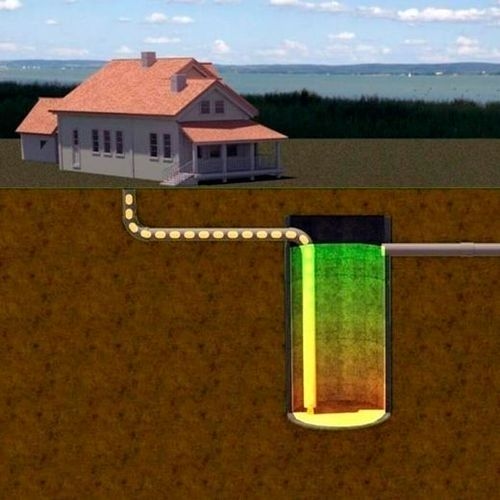
In this article, we will delve into three of the main tank systems, which can be used to understand other varieties of this process.
https://creativecommons.org/licenses/by-nc-nd/4.0/https://creativecommons.org/licenses/by-nc-nd/4.0/ArchShopArchShopIn this article, we will delve into three of the main tank systems, which can be used to understand other varieties of this process.
Septic tanks are the units responsible for the primary treatment of domestic sewage. This system might be new to those living in large cities with access to the sewage network, but for rural residents, it's a common option. Septic tanks serve as important alternatives to the lack of adequate sewage treatment.
Their main function is to separate and transform (physically and chemically) waste from bathrooms, kitchens, and laundry rooms in a safe and systematic way. These are simple and inexpensive processes that provide a palliative solution to the sanitation deficiencies of certain municipalities. Septic tanks are seen as palliative—meaning temporary—because the recommendation is to have a connection to a professional treatment station.
Data from the IBGE from 2017 (released in 2020) indicate that 4 out of 10 Brazilian municipalities did not have sewage services. This is a concerning number that contextualizes the motivations for the continuous construction of illegal tanks in the country. Besides not being regularized, illegal tanks are active threats and can lead to a range of damages.
Before we detail the risks of an illegal tank, let's better understand how it works, what the main models available today are, and which type is most suitable for installation. Come with us!
As we've mentioned, tanks are palliative solutions commonly found in rural areas or isolated residences. They play an essential role in improving the population's hygienic conditions and preventing the spread of diseases. Being a very popular and primitively originated system, it shows clear evolution in the methods found in its various models.
In this article, we will delve into three of the main tank systems, which can be used as a basis to understand other varieties of this process. We will explain the rudimentary tank, the septic tank, and the biodigester tank. We'll start with the simplest among them:
Data from the Continuous National Household Sample Survey (PNAD), conducted by the IBGE in 2019 and released in 2020, showed that 9 million Brazilian households indicated rudimentary tanks, ditches, rivers, lakes, the sea, and other forms of drainage as the destination for their waste. In percentage terms, this number corresponds to 12.6% of the country's households.
A rudimentary tank system consists of a hole dug in the ground where all domestic sewage is directed. There is no treatment involved in this process, and the waste accumulates in its natural state. There is a constant production of unpleasant odors and the proliferation of vectors. The lack of care allows the sewage to contaminate the soil, reaching surface and groundwater.
In Brazil, rudimentary tanks are a prohibited system in many municipalities, precisely because they pose great risks to health and the environment. Nevertheless, they are a method often found in areas lacking basic sanitation, consequently threatening poorer populations. It is important to raise awareness and offer alternatives that preserve their sanitary and hygienic conditions. For this, it is vital that such regions receive investment and proper inspection.
Contrary to what we saw in the previous model, septic tanks are designed to avoid potential risks. In the 2019 PNAD, the data showed 68.3% of Brazilian households with sewage disposal through the general network or a septic tank connected to the general network, while 19.1% had a septic tank not connected to the general network.
Septic tanks are considered primary treatment units for domestic sewage, thus differing from rudimentary ones which provide no treatment. Their system consists of stages that collect sewage from the entire house, separate the liquid and solid parts, and ensure that the liquid parts are treated and filtered, while the solid parts are decomposed by anaerobic bacteria in a process called decantation.
It all starts in the first tank, responsible for receiving all domestic sewage collection. In this tank, the process works with gravity to separate the solid and liquid parts. The solids are deposited at the bottom of the tank, while the liquids fill it up. Through an escape valve, the gases generated by fermentation are released.
When the liquids reach a certain point, they are transferred to a second tank. Here we have the filtration stage, done through stones, gravel, sand, or a filter medium. It is important to note that all elements of the process must be produced by a specialized company to ensure all stages are successfully completed.
The liquid resulting from the filtration is then transferred to a third and final tank, called a soakaway. Here the final liquid can either be returned to the environment or processed in another treatment stage when intended for reuse as potable water.
As we emphasized, all equipment used for the construction and installation of a septic tank must be done by professionals. Careless installations can lead to potential leaks. The material handled by the tanks is extremely infectious, not only for the residents of the region but also for animal and plant life.
The biodigester tank has a system similar to the septic tank, ensuring primary treatment of domestic sewage. It also prevents this sewage from being exposed and posing a contamination threat. These systems are actually related, as the biodigester tank comes from the septic tank process, with some additions that benefit the environment.
In 2000, inspired by the biodigesters of Asian countries, the then researcher at Embrapa (Brazilian Agricultural Research Corporation) Antonio Pereira Novaes developed the biodigester septic tank. While a regular septic tank requires frequent cleaning with the help of specialized, certified, and environmentally licensed companies, biodigester tanks do not require this type of maintenance.
In this system, we have the presence of biodigesters that transform the solid result (left in the first tank of septic tanks) into recyclable effluents. Its disposal can be done by anyone since it presents no health risks or bad smells. It is recyclable because it serves as fertilizer for crops not intended for consumption.
The biodigester septic tank is an important invention in the social and environmental fields. For it, Novaes received the Banco do Brasil Social Technology Award in 2003, and it remains a standout system in this field today. Naturally, it is the best option for areas that do not have a connection to the general public sewage network.
For its best performance, biodigester septic tanks only receive sewage from toilets. This selection aims to prevent chemical products (such as chlorine, disinfectants, and detergents) from coming into contact with the system. The chemical value of these products can influence the biodigestion process, leading to low efficiency. Normally, liquids from other spaces are taken directly to the second tank for the filtration process.
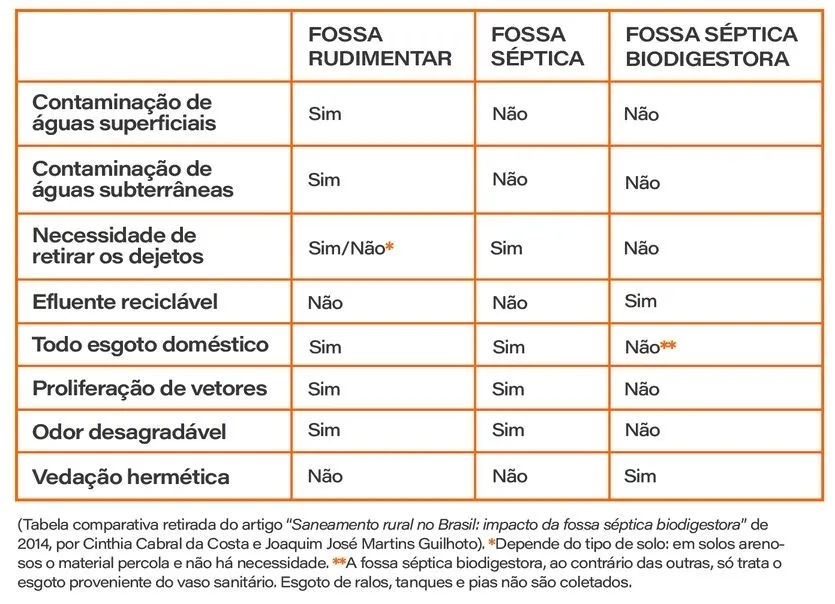
Below is a comparative table with all the characteristics of these three tank models:
During installation, tanks must be placed at predefined distances and depths. Their size can vary according to the need and the number of residents it will serve. It can be developed in different materials and types, such as precast tanks and those made on-site.
After installation, it is avoided that garages, gardens, swimming pools, and sidewalks are planned in nearby areas, as they can compromise its structure. It is also recommended to be aware that non-biodegradable materials do not invade its system, as well as the disposal of oil in drains: both can harm the flow and clog its pipes.
As we mentioned throughout the article, septic tanks are systems that must be handled with care. They are responsible for handling highly polluting materials, which can cause numerous negative effects on human or environmental contact. Tanks that need assistance should be visited by specialized professionals every 6 months.
It is important to pay attention to the regularity of maintenance, regardless of whether the tank is a biodigester or not. To ensure advantageous performance, being in contact with companies in the field is essential. We reiterate again that septic tanks are palliative solutions, recommended only in the absence of public sewage treatment.
 https://creativecommons.org/licenses/by-nc-nd/4.0/https://creativecommons.org/licenses/by-nc-nd/4.0/ArchShopArchShop
ArchShop is redefining the concept of residential architecture in Brazil, making high-quality projects accessible to everyone. Combining over 20 years of expertise in the construction sector with technological innovation, the company offers a complete digital platform that simplifies and democratizes the process of building the dream home.
See also
In this article, we will delve into three of the main tank systems, which can be used to understand other varieties of this process.

When considering the construction of a new property, choosing the right lot is a crucial factor to consider.

A cistern is a water reservoir used to collect, store, and reuse rainwater.

When planning the construction of a house, one of the most important aspects to consider is the choice of the roof.
Advertise or Publish
We believe that the best ideas arise from the exchange of experiences and the sharing of different perspectives. Open the doors to new opportunities and be part of our blog! If you have an interesting article, an amazing work, a product or service that deserves to be highlighted, contact us.